
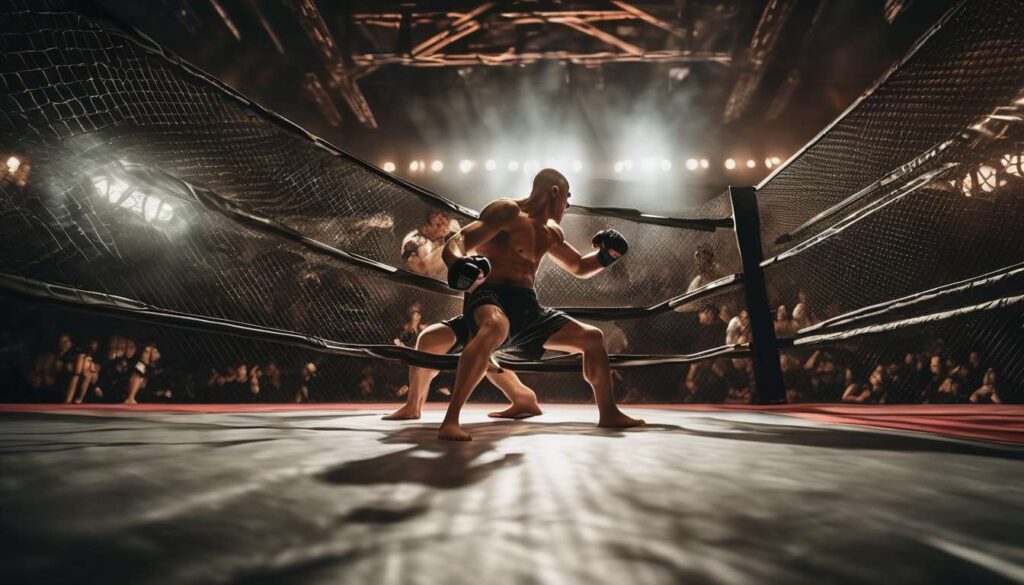
In the world of mixed martial arts, the octagon is more than just a battleground; it’s an intricate psychological landscape where every step and every breath can dictate the outcome of a fight. As enthusiasts and analysts of this dynamic sport, we find ourselves constantly fascinated by the concept of octagon control.
Octagon control is not just about physical dominance but also about mental strategy and psychological warfare. Fighters utilize:
- Spatial awareness
- Movement
- Mental fortitude
to assert dominance over their opponents.
Through this article, we aim to delve into the nuances of cage psychology. We will examine how elite fighters leverage octagon control to gain an edge. By understanding these elements, we not only appreciate the complexity of the sport but also gain insights into how mental and physical strategies intertwine.
Our goal is to unravel the mysteries of the octagon, revealing how it creates the captivating spectacle that is mixed martial arts.
The Importance of Spatial Awareness
Spatial Awareness plays a crucial role in understanding how individuals interact with their environment and the psychological effects of confined spaces.
As a team, we recognize that mastering spatial awareness isn’t just about knowing where we are; it’s about understanding how to use every inch of our environment to our advantage. Our shared journey in honing this skill ensures we move with purpose, creating a sense of unity and strength.
Footwork becomes our language, speaking volumes about our intentions and strategy. When we’re in sync, our movements are fluid and intentional, allowing us to navigate spaces efficiently.
- Precise footwork can disrupt an opponent’s rhythm
- Gives us the upper hand
Psychological Tactics are just as crucial. By reading our environment and opponents carefully, we can anticipate their moves and respond with confidence.
Together, we create a psychological edge, fostering a sense of belonging and camaraderie that empowers us to face any challenge head-on.
Dominating Through Movement
By mastering movement, we transform our physical presence into a powerful tool that commands respect and control within any space. With precise footwork, we navigate the octagon like a chessboard, each step calculated to maintain our advantage. Our spatial awareness allows us to anticipate and react swiftly, keeping us one step ahead of our opponent. It’s not just about moving; it’s about moving with purpose and intention.
We understand that dominating through movement involves more than physical prowess; it requires psychological tactics.
- Our controlled movements disrupt our opponent’s rhythm, creating openings for us to exploit.
- We dictate the pace, forcing them to follow our lead.
- As we shift and pivot, we subtly influence their decisions, guiding them into positions where they’re most vulnerable.
Together, we cultivate an environment where our presence is felt before we even make contact. In doing so, we foster a sense of unity and shared purpose, reminding us that every step taken is a step towards victory.
Harnessing Mental Fortitude
Our mental fortitude becomes the foundation upon which we build resilience, allowing us to remain focused and composed under pressure.
Together, we develop a sense of unity and purpose, enhancing our spatial awareness as we navigate the octagon. By mastering our mental state, we’re not just reacting—we’re anticipating. This mental edge helps us read our opponents, giving us the ability to predict their next move and use our footwork effectively.
Psychological tactics play a crucial role in our approach. We employ them to unsettle our opponents, throwing them off balance mentally before they know it. It’s about more than just physical prowess; it’s about creating an environment where we feel in control, and they feel out of place.
Through shared experiences and training, we support each other in strengthening this mental resilience. This ensures that when the moment comes, we’re ready to face any challenge head-on.
Together, we harness our mental fortitude, making us formidable inside the cage.
Tactical Footwork Strategies
Incorporating precise movements, we use tactical footwork to control the pace and positioning of the fight. Our ability to read our opponent’s intentions and respond with agility creates a dynamic dance within the octagon. It’s not just about moving; it’s about moving with purpose.
Each step we take is calculated, enhancing our spatial awareness and allowing us to anticipate and react to our opponent’s maneuvers.
By mastering footwork, we create psychological pressure, making our opponent second-guess their approach. They feel the weight of our presence, knowing we’re always one step ahead.
Our movement is:
- Fluid
- Unpredictable
This keeps them on edge and forces them into positions where they’re less comfortable.
Our community thrives on this shared understanding of the subtle art of movement. Together, we embrace these psychological tactics, knowing that every pivot and sidestep is a testament to our dedication.
Through unity and practice, we elevate our game, supporting one another in the pursuit of octagon mastery.
Controlling the Center of the Octagon
Dominating the Center of the Octagon
Dominating the center of the octagon allows us to dictate the flow of the fight and keep our opponent on the defensive. By maintaining control here, we demonstrate superior spatial awareness, making every move deliberate and calculated.
Footwork as an Ally
- Our footwork becomes our strongest ally; it’s not just about staying in the center, but doing so with precision and fluidity.
- We step with purpose, ensuring our stance is always ready to engage or evade.
Psychological Tactics
Our presence in the center isn’t just physical—it’s a psychological tactic. We create an aura of confidence and control that unsettles our opponent. They’re forced to circle the perimeter, reacting to our movements rather than initiating their own.
Commanding Position
This commanding position fosters a sense of belonging within the octagon, where we set the pace and rhythm of the encounter.
Owning the Space
Together, we harness these skills to not only occupy space but to own it, transforming the center of the octagon into our domain.
Mind Games and Psychological Tactics
In the octagon, we wield psychological tactics as a weapon to disrupt our opponent’s mindset and gain a strategic edge. This isn’t just about brute strength or agility; it’s about outsmarting and unsettling our rival.
We hone our spatial awareness, understanding the cage’s dimensions to create traps and dictate the fight’s pace. Our footwork becomes a dance, a calculated performance meant to confuse and mislead, keeping our adversary guessing and on the defensive.
Psychological tactics aren’t merely mind games; they’re an integral part of our strategy. Through subtle feints and sudden shifts, we instill doubt and hesitation. We make our opponent question their next move, creating openings where none seemed to exist.
Together, we embrace this mental chess match, knowing that victory often lies not just in physical prowess but in the mastery of the mind. In this shared pursuit, we find a deeper connection, a belonging to the artistry that is the fight.
Reading Opponent’s Body Language
Deciphering Opponent’s Body Language
We focus keenly on our opponent’s body language, deciphering subtle cues that reveal their intentions and vulnerabilities. Every shift in posture and every glance provides us with valuable insights.
Spatial Awareness
Our spatial awareness allows us to understand how they navigate the octagon, revealing their comfort zones and hesitations. By observing their footwork, we can gauge their level of confidence and readiness, predicting their next move.
- Are they light on their feet?
- Do they seem rooted or hesitant?
These observations help us feel connected, like we’re in sync with the rhythm of the fight.
Psychological Tactics
Psychological tactics come into play as we mirror their movements, creating a sense of unpredictability. We maintain eye contact, challenging them mentally, showing that we’re not just physically prepared but also mentally resilient.
Silent Conversation and Community Appreciation
This shared understanding of the battlefield creates a deeper connection, a silent conversation where words aren’t necessary. Together, with the community of fighters and fans, we appreciate this intricate dance within the cage.
Capitalizing on Angles and Openings
By strategically positioning ourselves, we exploit angles and openings to maximize our offensive and defensive maneuvers.
As a unified force in the octagon, our spatial awareness becomes a crucial ally. We move with intent, using footwork to dance around our opponents, creating opportunities where others see none. It’s not just about physical agility but understanding the psychological tactics that lead to victory.
When we control angles, we’re not merely reacting; we’re dictating the pace and direction of the fight.
Our collective effort ensures that we remain unpredictable, keeping opponents guessing and off-balance. We create openings not just with our bodies but with our minds, anticipating their moves and countering with precision.
Through shared experiences, we learn to read the subtle cues in our opponent’s movements, exploiting their weaknesses and capitalizing on every opportunity.
Together, we craft a strategy that resonates with our desire for unity and success, making us formidable inside the cage.
How does the choice of footwear impact a fighter’s ability to control the octagon?
When discussing how footwear affects a fighter’s ability to control the octagon, it’s essential to find the right balance between grip and mobility.
Impact of Shoes on Movement and Stability:
-
The type of shoes a fighter wears can significantly impact their movement and stability in the cage.
-
Lightweight shoes with good traction can help fighters move quickly and cut angles effectively.
-
Conversely, heavier shoes might slow fighters down and limit their agility.
Choosing the Right Footwear:
-
Identify your fighting style and the specific support you need.
-
Opt for shoes that enhance both speed and agility.
-
Ensure the shoes provide the necessary traction without compromising mobility.
In summary, it’s crucial to choose footwear that suits your fighting style and provides the support you need to maintain control in the octagon.
What role does a fighter’s diet and nutrition play in maintaining focus and energy during a fight?
Maintaining focus and energy during a fight is crucial, and a fighter’s diet and nutrition play a significant role in achieving this.
Key elements for optimal performance include:
- Eating well-balanced meals
- Staying hydrated
- Fueling the body with the right nutrients
We prioritize nutrition to ensure stamina and mental clarity, which are essential to outlasting opponents in the octagon.
A healthy diet is a cornerstone of our fight preparation, enabling us to perform at our best.
How do fighters train differently for various cage sizes and shapes?
When preparing for fights in different cage sizes and shapes, we adjust our training to simulate those specific conditions.
This includes:
- Sparring in similar-sized rings
- Working on footwork and angles that suit the cage dimensions
- Strategizing on how to capitalize on the space available
By tailoring our training to the fight environment, we can adapt more effectively during the actual competition and maximize our performance potential.
Conclusion
In conclusion, mastering octagon control is key to dominating in the cage.
By honing your:
- Spatial awareness
- Mental fortitude
- Tactical footwork strategies
you can dictate the pace of the fight and keep your opponent on the defensive.
Utilizing psychological tactics, reading body language, and capitalizing on angles will give you the edge needed to secure victory.
Remember, the center of the octagon is your domain—control it, and you control the fight.